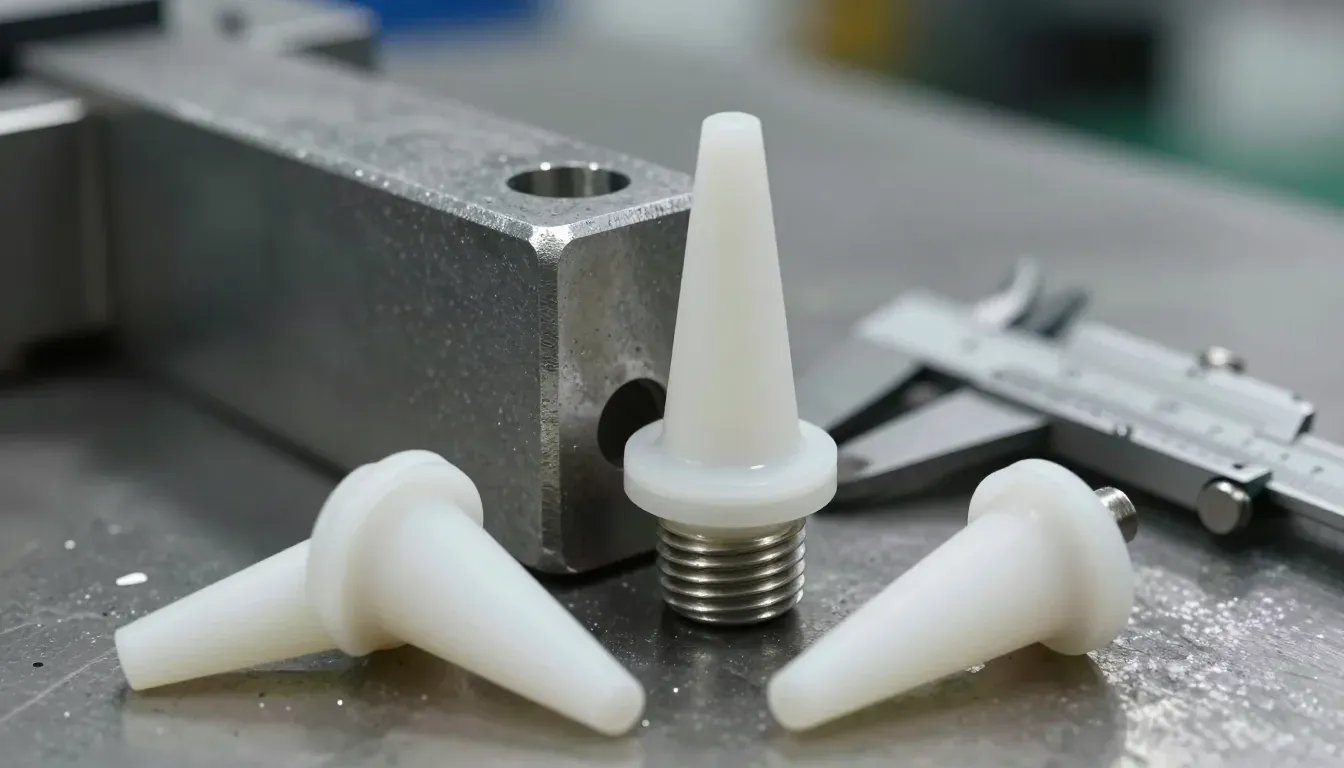
Conical, Threaded, Stepped and Flanged Plugs: What Is the Difference
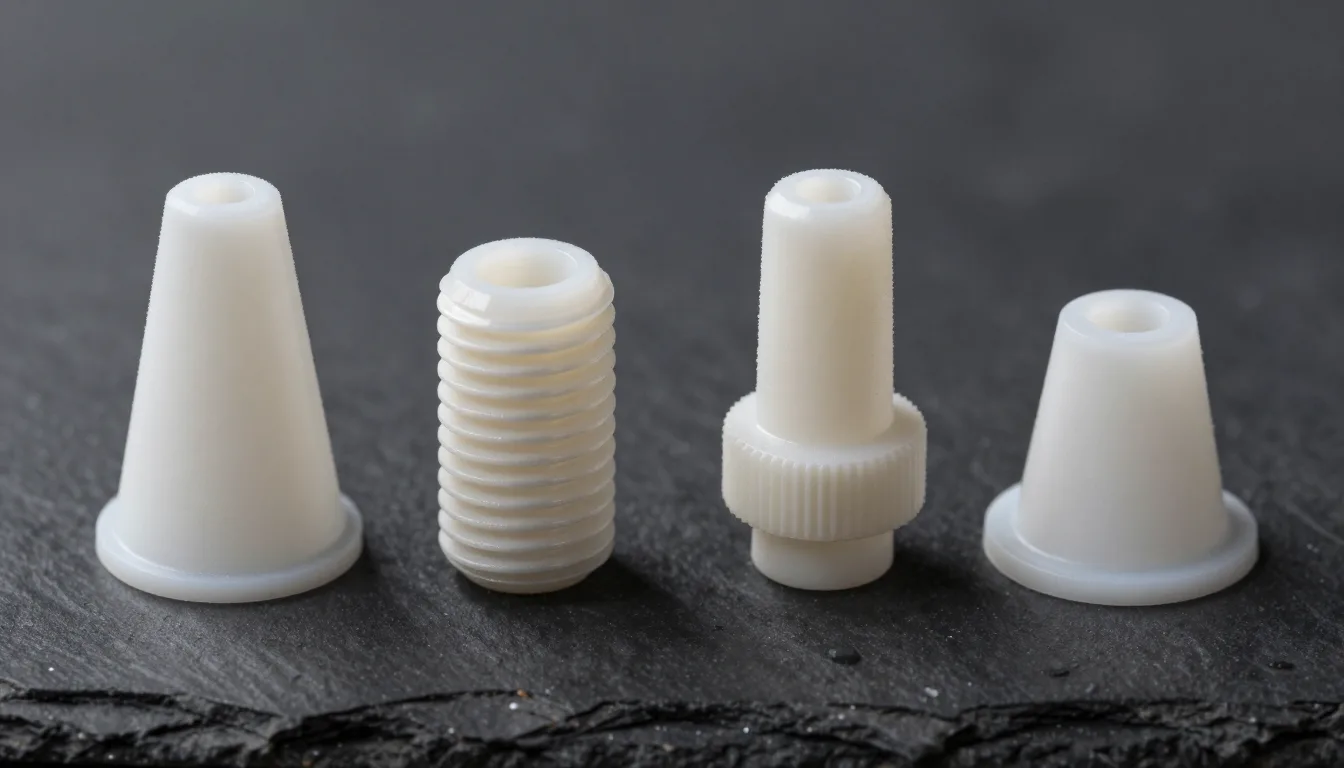
The difference between conical, threaded, stepped and flanged masking plugs comes down to body geometry and the way the plug holds in the hole. A conical plug centers itself under light pressure, a threaded plug follows the internal thread, a stepped plug closes a bore that changes diameter, and a flanged plug protects the surface around the hole as well as the hole itself.
Most shops choose a plug by measuring the hole diameter and stopping there. That works until two holes of the same diameter behave differently because one is blind and the other goes straight through, or because one carries a thread and the other is plain. The wrong body type shows up later as a plug that has shifted in the oven, powder baked onto the threads, or a bolt that will not run down by hand. This guide separates the four families and shows where each one earns its place.
Conical plugs: self-centering by design
A conical plug widens from tip to base. The narrow end enters first and the body approaches the bore wall as the plug moves inward. That taper pulls the plug toward the hole axis without any special effort from the operator. A firm push with the thumb is usually enough, which is why conical plugs dominate high-volume lines.
The practical advantage is range. One conical size can cover a small spread of hole diameters. A plug sized for 8 mm to 9.5 mm will seat in any bore within that band, so a shop running many different parts can cut the number of stock items. SMT conical plugs are the most common body in this family for exactly that reason.
The taper also sets the limit. Holding force depends on how far the body advances into the hole. In a deep blind hole the plug may reach the bottom before the walls grip it properly. In a shallow hole the plug sits proud and can be knocked loose inside the oven. Note the bore depth when you order, not just the diameter. On a through hole, a single-sided conical plug can be pushed out from the far side. A double-ended UW twin conical plug solves that problem because it seats from either direction.
Threaded plugs: protecting the thread itself
A threaded plug carries an external thread that matches the internal thread of the hole. It is turned in, not pushed in. Once seated, there is no open path between the thread crests and the plug. Powder or liquid coating cannot creep toward the thread root.
The critical dimension is the thread, not the hole diameter. Standard threads such as M6 x 1.0 and M8 x 1.25 differ in pitch, and a plug cut for the wrong pitch will bind after one or two turns. If the operator forces it, the thread flanks can be flattened. Checking the pitch with thread gauges before ordering is the cheapest inspection a shop can perform. DFP threaded plugs are built for metric threaded holes where the thread has to survive the coating line intact.
There is a second benefit that often goes unnoticed. Because coating does not build up in the thread root, the fastener reaches its torque target with fewer surprises. On automotive and appliance lines this directly affects rework. Remove a threaded plug by turning it out, not by pulling. Pulling a hot plug can score the crests it was supposed to protect.

Stepped plugs: bores that change diameter
Not every hole has a single diameter. A counterbored hole has a wide section followed by a narrow one. A casting may include a shoulder inside the bore. A stepped plug uses two or three diameters on one body so it can seat in that geometry without a second part.
The step order has to match the bore. The plug should enter through the wide section and grip in the narrow one. Fit it backwards and the narrow step stops at the mouth while the wide step floats in open space, which leaves no seal. SPP stepped plugs cover counterbored and shouldered holes when both diameters and both depths are supplied with the order. Guessing the step order is the most common reason a stepped plug leaks.
One stepped plug can do two jobs: close the narrow bore and protect the wall of the wide section. That matters when the face around the hole must stay bare for a mating part. Replacing it with two separate plugs adds handling time and doubles the chance that one of them is missed.
Flanged plugs: protecting the surface around the hole
A flanged plug has a disc above the body that is wider than the hole. The disc lands on the part surface and stops the plug from falling through. On thin sheet metal this is not a minor detail. A plain conical plug can disappear into a slightly oversized hole as soon as the rack vibrates.
The flange also masks the annular area around the bore. If coating builds up where a bolt head or washer has to sit, the fastener will not seat flat. A flanged plug keeps that ring clean and controls coating thickness at the joint. SCT flanged conical plugs combine a conical body with a protective flange, which is why they appear often on visible surfaces.
Flange diameter is a trade-off. A larger flange protects more area but can overlap a neighboring surface that must be coated, leaving a bare patch. Check the flange outline against the actual part before committing. Flange thickness matters too. A very thin flange can soften and bond to the surface during cure, especially if the part is handled while still warm.
The four types side by side
The table below compares the body types as they would be evaluated during selection. The warning column lists the failure that comes back most often from the field.
| Type | Body geometry | Best use | Watch out for |
|---|---|---|---|
| Conical (SMT) | Body widening from tip to base | Round holes, fast fitting, narrow size range | Weak grip in very deep holes |
| Threaded (DFP) | External thread matching the bore | Metric threaded holes, fastener thread protection | Wrong pitch damages the thread |
| Stepped (SPP) | Two or three diameter steps | Counterbored, shouldered and variable bores | Can be installed backwards |
| Flanged (SCT) | Conical body with a wide head | Thin sheet, visible surfaces, bolt seating faces | Flange can overlap a coated area |
| Twin conical (UW) | Taper on both ends | Through holes, direction-independent fitting | Mid-bore gap must not be too wide |
| Push-in (STM) | Cylindrical body with a grip groove | Straight bores needing a firm fit | Grip drops when the groove is dirty |
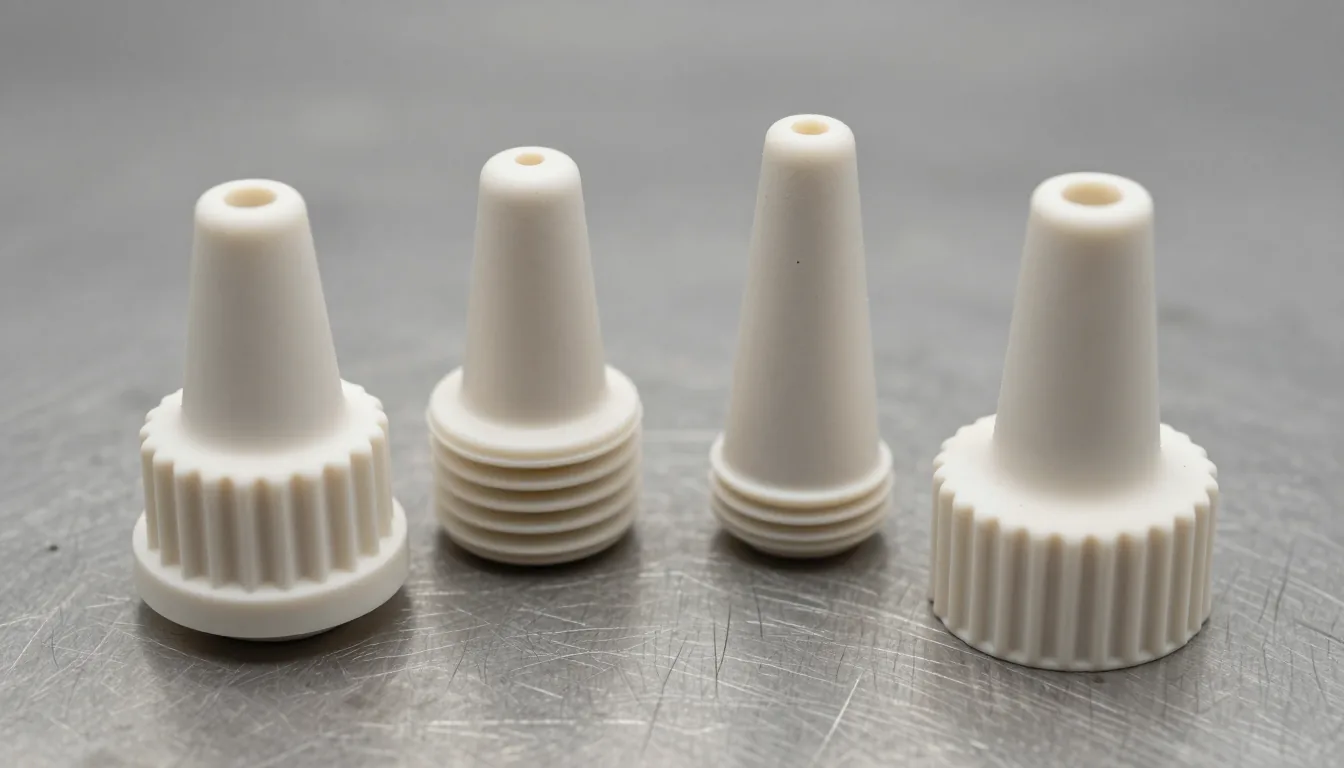
The selection sequence in five questions
Ask these five questions in order. The first two narrow the body family. The last three settle the size.
- Is the hole blind or through? A blind hole accepts a single-sided plug. A through hole needs a twin-ended or flanged body.
- Is there a thread? If yes, use a threaded plug. If no, choose conical or stepped.
- Is the diameter constant? A counterbore, shoulder or tapered section calls for a stepped plug.
- Must the area around the hole stay bare? A bolt seating face, washer seat or visible ring points to a flanged model.
- What is the oven temperature and hanging direction? A downward-facing hole loads the plug with gravity. Choose a body with stronger retention.
Run this sequence before opening a size chart. Most failures do not come from picking the wrong size within the right family. They come from picking the wrong family altogether. An 8 mm conical plug in an M8 threaded hole looks reasonable at a glance, but it never engages the thread. It holds only at the mouth, and the oven does the rest.
Where the types get confused on the floor
The four bodies can look similar enough that the mistake only appears at removal. These are the mix-ups we see most often:
- Forcing a conical plug into a threaded hole: the plug rides on the crests, wears them, and loosens in the oven.
- Using an unflanged plug on a visible surface: a coating thickness step forms around the hole and triggers a quality rejection.
- Installing a stepped plug backwards: it looks seated, but the narrow step stays at the mouth and the seal fails.
- Using a single-sided plug in a through hole: the plug is pushed out from behind and drops into the line.
- Greasing a threaded plug: the grease burns in the oven and leaves residue in the thread root. Fit dry.
Every item on that list shares one assumption: that a plug only has to block a hole. In practice the plug also behaves like a gauge. The wrong type distorts the bore geometry and the mating surface, and the cost appears at assembly rather than at masking.
The economics deserve a mention. Saving money on a box of plugs can cost more than a single thread repair on the assembly line. Once you add the time spent chasing threads after coating, the cost of taps and the labor rate, the correct plug usually pays for itself. That is why the selection should sit with the team that runs the line, not only with purchasing. The operator knows which hole keeps shifting and where powder collects.
What to send with an order
A photo of the part, a close-up of the hole and the measured dimensions are enough to get the type right the first time. Put a caliper or a ruler next to the hole in the photo so the scale is clear. For a threaded hole, include the pitch. For a stepped bore, list the diameter and depth of each section. Oven temperature, hanging direction and annual quantity also affect the choice.
If a standard body fits, you can pick a size from the silicone plug caps category. If the geometry is non-standard, for example oval, slotted or interrupted by a rib, a custom design is the realistic route. That process starts with a photo and dimensions and continues through tooling and sample approval. Two photos from different angles are enough for us to confirm which family fits.
Frequently asked questions
Can a conical plug be used in a threaded hole?
In an emergency, yes, but it is not a durable solution. A conical body does not engage the thread, so it is far more likely to shift in the oven. A threaded plug protects the thread and lasts longer in the same position.
Does a flanged plug fit every part?
The flange needs a flat seating area around the hole. If the surface is curved, domed or very narrow, the flange will not make full contact. Use a smaller flange or a plain conical body in that case.
How do I measure for a stepped plug?
Measure the diameter and depth of each section separately. The widest section sets the upper step and the narrowest section sets the lower step. Tell the supplier whether the transition is sharp or chamfered, because that detail changes how the plug seats.
Can one part use more than one plug type?
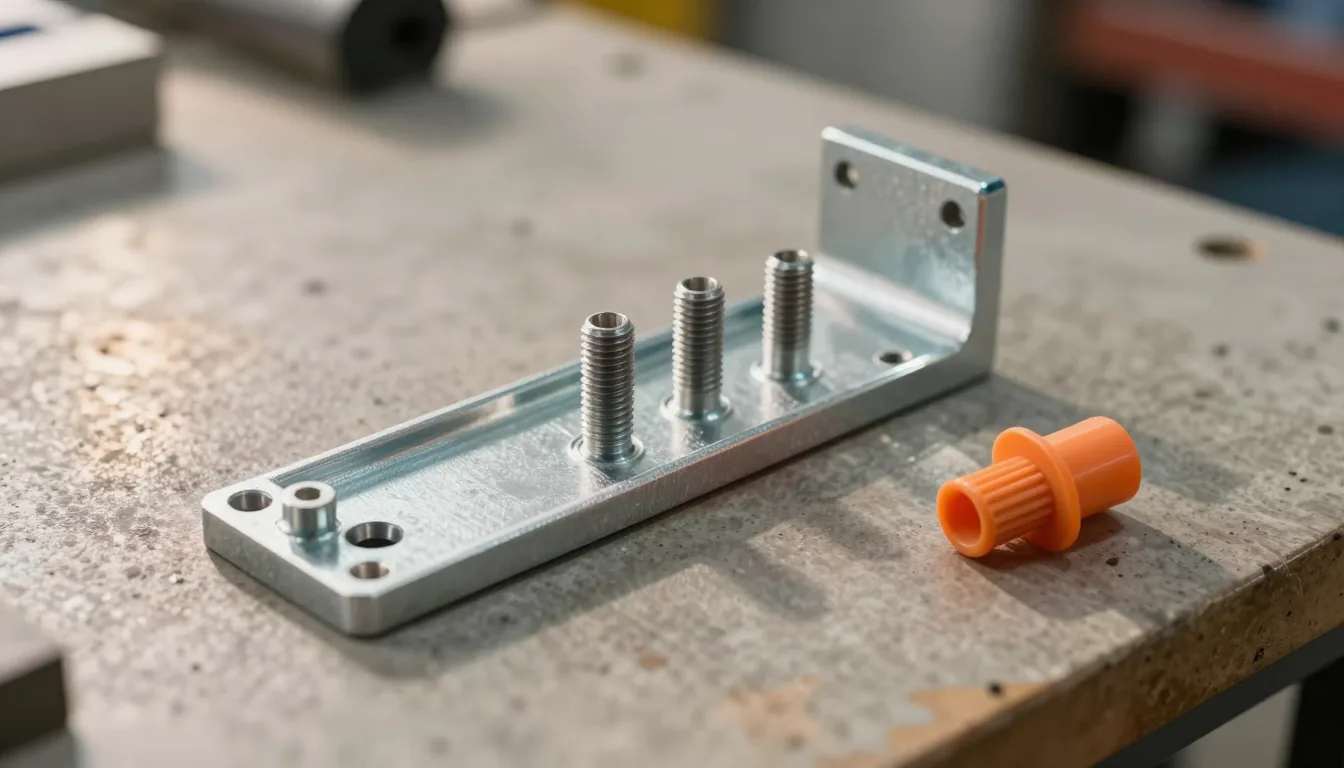
Yes. A single bracket may have threaded holes, through holes and a visible face that must stay bare. Match each hole group to its own plug. Forcing one type everywhere weakens protection somewhere on the part.
Which type lasts longest?
Service life depends more on operating conditions than on body type. Threaded plugs see less mechanical stress, while conical plugs are fitted and removed more often. Correct sizing, clean holes and a sensible removal temperature extend the life of all four types.
Looking for Professional Silicone Masking Solutions?
As YÜZEYTEK, we provide professional silicone masking and industrial coating solutions worldwide. Contact us immediately for your needs.
Related Posts

Plastisol Viscosity: The Right Setting for Dip and Spray
Kapton Tape Residue: 4 Causes and Prevention