Silicone Plugs Guide: Types, Applications, and How to Choose SMT or DFP
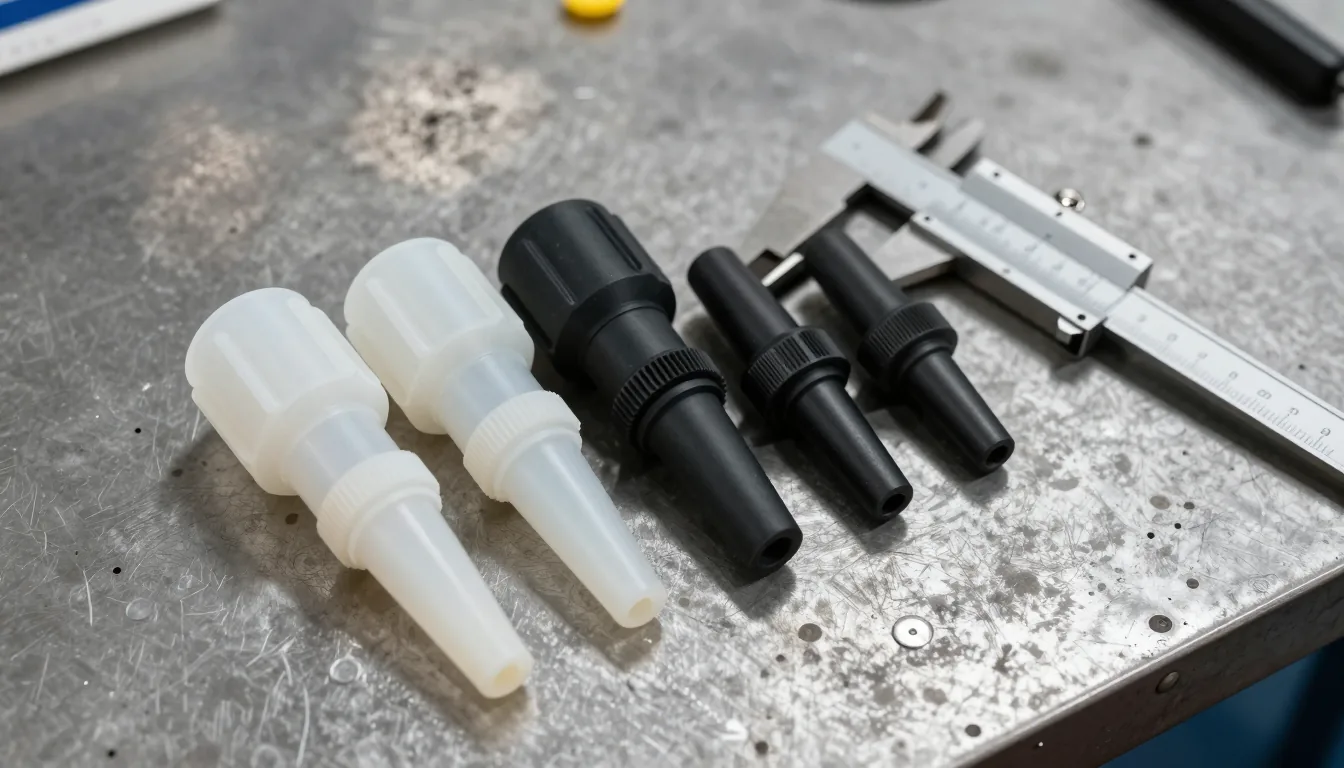
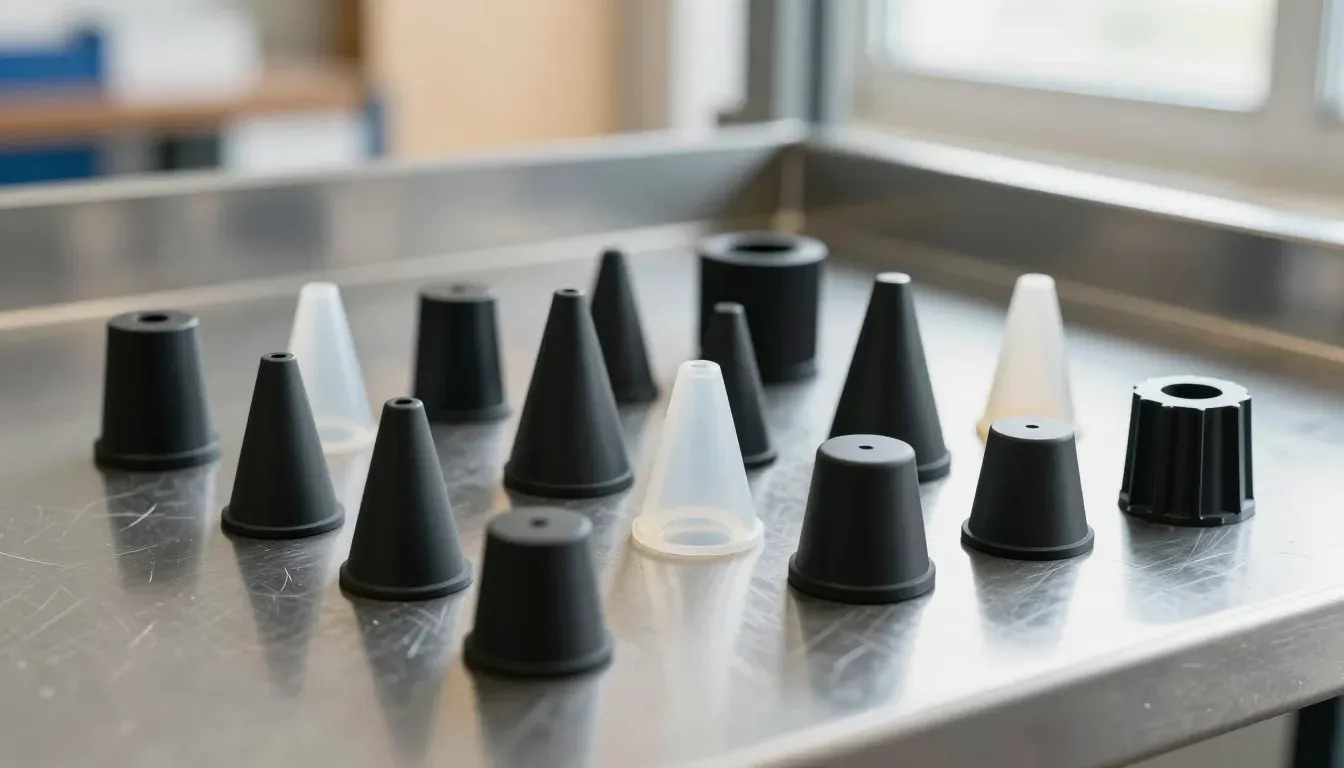
Silicone masking plugs are the shared category for flexible silicone parts that temporarily close holes, threads and channels on coating lines. The category covers tapered, threaded, stepped and flanged bodies under one roof. What ties them together is the material and the job: the part seats in or over a bore, survives the oven and pulls out without marking the finish.
This guide treats the category as a selection framework, not a catalogue page. It shows which family belongs to which hole, which products sit outside the boundary, and which six details a supplier needs before quoting. Use it before you open a product page and the code choice becomes much shorter.
International Naming Conventions for Silicone Masking Plugs
Buyers, drawings and packing lists rarely use the same words. The table below gives the official name of the category in several languages with an approximate Latin reading. The readings follow everyday speech, not phonetic script.
| Language | Written form | Approximate Latin reading |
|---|---|---|
| Turkish | Silikon Tapa-Tıpalar | si-li-kon ta-pa tı-pa-lar |
| English | Silicone Masking Plugs | si-li-kohn MAS-king plagz |
| German | Silikon-Maskierstopfen | zi-li-KOHN mas-KEER-shtop-fen |
| Russian | Силиконовые маскировочные пробки | si-li-KO-no-vy-ye mas-ki-RO-voch-ny-ye PROB-ki |
| Arabic | سدادات سيليكون للحجب | si-da-daat si-li-koon lil-hajb |
| Spanish | Tapones de silicona para enmascarar | ta-PO-nes de si-li-KO-na pa-ra en-mas-ka-RAR |
| Polish | Silikonowe korki maskujące | si-li-ko-NO-ve KOR-ki mas-ku-YON-tse |
| Romanian | Dopuri de mascare din silicon | DO-pu-ri de mas-KA-re din si-li-KON |
The table is useful in quotation threads. On Russian and Arabic orders, add the product code in Latin letters next to the local name. A buyer reading SMT or DFP knows the family immediately, even when the translated term differs between two suppliers.
Scope and Limitations of the Silicone Plug Category
Three conditions define membership. The body is moulded in silicone, the tip is closed and solid, and the part can be pulled and reused. Part of the body enters the bore and physically stops paint, powder or bath liquid from travelling inside.
Two examples settle the boundary. A flanged tapered plug belongs here because its body sits inside the hole. A silicone cap does not: it covers the outer face and never enters the bore, so it belongs to a separate category. Both may use the same silicone compound, but their purpose and measuring logic differ.
- Inside the category: tapered plugs, threaded plugs, stepped plugs, flanged tapered plugs, double tapered plugs, push-in cylindrical plugs.
- Outside the category: silicone caps, PVC vinyl caps, test seals, grommets, masking tapes, plastisol coatings.
- Border case: finger-grip tapered plugs count as plugs because the body enters the bore while the ribs rest on the face.
The boundary matters for sizing. A plug is chosen from the bore diameter. A cap is chosen from the outer diameter and wall thickness of the part. Ask for the wrong category and the first sample round will not fit.
The category is silicone only. When the same job can be done in PVC vinyl, the product moves to the PVC range. PVC runs from -60 °C to +177 °C, is stiffer and costs less. Above 177 °C in the oven, PVC is out. That temperature line is the cleanest split between the two categories and the first question in any quotation.

Product Families: SMT, DFP, SPP, and SCT Codes
Each family carries a code. The code describes the body geometry, and the geometry decides which hole it serves. Using the code in drawings and purchase orders prevents two similar sounding products from being mixed up.
| Code | Family | Body geometry | Typical use |
|---|---|---|---|
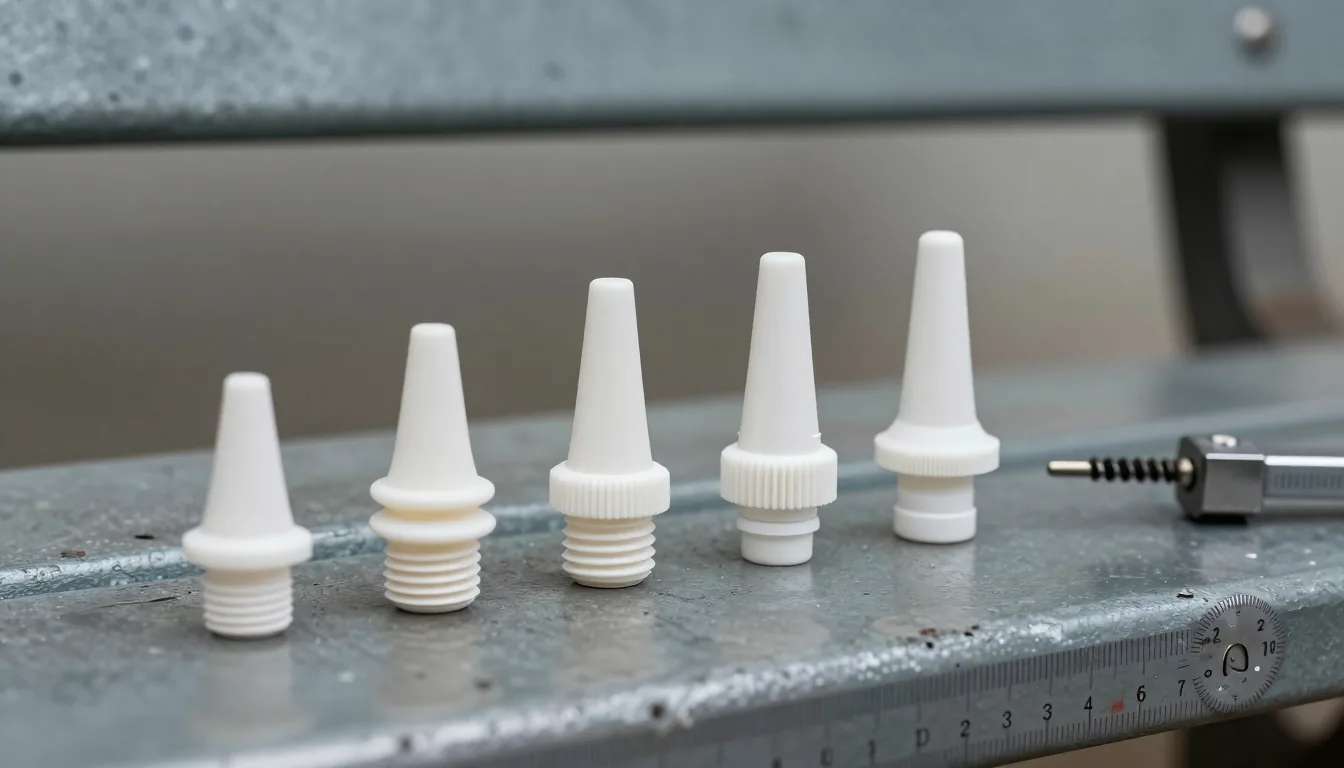
| SMT | Tapered plugs | Smooth gradual cone | Round holes across a range of diameters |
| DFP | Threaded plugs | Body matched to the thread profile | Metric threaded holes |
| SPP | Stepped plugs | Two or more diameter steps | Holes that narrow along their depth |
| SPM | Step plugs | Wide step body | Holes that need a step seat |
| SCT | Flanged tapered plugs | Cone plus an anti-flood flange | Protecting the face around the hole |
| DFPP | Double flanged plugs | Body between two flanges | Thick sheet and two-sided parts |
| UW | Double tapered plugs | Taper from both ends | Fitting from either side |
| STM | Push-in plugs | Cylindrical body with a retaining groove | Straight bores that need a firm fit |
| YMTP | Stepped tapered plugs | Cone with a stepped transition | Funnel shaped hole mouths |
| TRK | Finger-grip tapered plugs | Cone with retaining ribs | Downward facing holes |
Understanding SMT Tapered and SPP Stepped Plug Bodies
A taper lets one plug work across a range of diameters, which is why SMT tapered plugs are the first choice on lines that need fast fitting. A stepped body does the opposite job: it gives each diameter its own seating face. The transition diameter has to match the real part, so step dimensions sit on the product page rather than in a general guide.
SPP stepped plugs are used where the bore has two or more diameters and each step should land on its own shoulder. A single-diameter hole usually needs only a cone. If the mouth carries a light countersink, a stepped body sits more squarely. More steps also mean orientation matters: a stepped plug fitted the wrong way enters halfway and can move in the oven.
DFP Threaded and SCT Flanged Tapered Plug Designs
A threaded body seats in the thread pitch and resists sliding during the oven cycle. DFP threaded plugs are used mainly to keep assembly threads clean. A flange limits how far the body enters the bore and shields the face around the hole from coating build-up. SCT flanged tapered plugs are chosen for visible surfaces. The flange is not a seal; its job is to hold position and protect the face.
Selecting Plugs by Shape, Hole Type, and Temperature
Selection starts with three questions. What shape is the hole, is there a thread inside it, and how hot does the line run. The table links the common answers to a family.
| Hole condition | Recommended family | Reason |
|---|---|---|
| Straight round hole, one diameter | SMT tapered | The taper absorbs diameter tolerance |
| Metric threaded hole | DFP threaded | Seats in the pitch and resists movement |
| Bore that narrows with depth | SPP stepped | Each step lands on its own shoulder |
| Visible face around the hole | SCT flanged | The flange keeps coating off the face |
| Thick sheet, access from both sides | DFPP double flanged | Two flanges centre the body |
| Downward facing hole | TRK finger grip | Ribs resist gravity |
| Blind bore with a flat base | STM push-in | The cylindrical body grips the wall |
Temperature narrows the material choice to one: silicone. Our data sheets put silicone service between -90 °C and +315 °C. Powder coating ovens run at 180-220 °C and e-coat curing at 180-200 °C, so the plug sits comfortably inside its window. Shore A hardness runs from 45 to 80 depending on the variant, with 50-80 and 55-60 the common production bands. Thin walls take the softer end, interference fits take the harder end.
Two shop floor details are easy to skip. First, burrs at the hole mouth. A cone seats on the burr instead of the bore, and coating creeps underneath. Second, heat distribution inside the oven. Racks near the door can read hotter than the set point on the panel. Plugs working in those positions deserve a margin below their upper limit. Hanging the hole horizontally also makes it harder for gravity to pull the plug out.
Differences from Our General Silicone Masking Plug Guide
The basic article follows one plug through the line: fit before coating, oven, removal. This article draws the map. It shows which family belongs to which hole, what the codes mean and where the category stops. The two texts do different jobs and do not replace each other.
The practical difference appears at the desk. A production engineer who reads the basic article fits the plug correctly. A purchasing team that reads this category guide asks for the right family and the right code. Opening the silicone masking plugs page with the codes in hand is the shortest route before a quote.
Essential Details for Silicone Plug Quote Requests
Six details are enough for an accurate quote. A price given without them usually comes back revised and costs a week.
- Hole diameter: largest and smallest reading from calipers, measured in two directions.
- Thread data: metric size and pitch, confirmed with a thread gauge where a thread exists.
- Hole depth: for blind bores, the reading from the base to the face.
- Line temperature: oven set point and any drift measured near the door.
- Part and rack layout: hole direction, how the part hangs, the angle of the spray gun.
- Annual volume and reuse expectation: this separates a consumable from a permanent tool.
Add a photo of the part and most families can be marked without opening a dimension table. Confirm the final size on the product page anyway; this guide deliberately avoids size numbers because they change with step and hardness.
Common Misconceptions About Silicone Plug Applications
Most confusion on the floor starts with asking for a cap when a plug is needed. Second is choosing a tapered plug for a threaded hole. Third is treating a flange as a seal. In all three cases the fault is definition, not supply.
- Cap instead of plug: a cap covers the outside face and never enters the bore. If the inside must stay clean, a plug is required.
- Taper in a threaded hole: the cone does not seat in the pitch and moves in the oven. A thread means the DFP family.
- Flange as a seal: the flange holds position and protects the face. It is not designed to seal under pressure.
The simplest prevention is a quotation form that makes the hole photo and thread data mandatory. Once those two fields are filled, the category usually names itself.
Frequently Asked Questions About Industrial Silicone Plugs
Silicone Masking Plugs vs. Silicone Caps: Key Differences
A plug enters the bore and protects the inside surface. A cap covers the outer face and never enters the hole. Sizing follows the same logic: bore diameter for a plug, outer diameter and wall thickness for a cap.
Why One Category Includes Multiple Product Codes
Each code stands for one body geometry. Change the hole shape, the thread, the visibility of the face or the hanging direction and the safest seating method changes. The range removes the need to force one body into every hole.
Maximum Operating Temperatures for Silicone Plugs
Silicone parts work from -90 °C to +315 °C. Powder coating at 180-220 °C and e-coat at 180-200 °C stay well inside that range. If the line approaches the upper limit, verify per batch.
Locating Technical Dimension and Size Charts
Each family carries its own table on its product page. This guide gives no dimensions because the correct value depends on the step and the hardness variant you select.
Best Practices for Using Silicone Plug Categories
Look at the hole shape first, confirm whether a thread is present, then decide whether the face is visible. That order makes the code choice almost automatic. Silicone masking plugs have been part of our production in Tuzla, Istanbul since 2014. To pin down the right code we need the part size, thread data and oven temperature; the rest we can settle together.
Once the category is set, reordering is a matter of repeating the same code. Record the measurements and the part photo with the first quote, and later batches will not drift. If one part needs two families for different faces, list them as separate lines on the request so production planning sees both from the start.
Looking for Professional Silicone Masking Solutions?
As YÜZEYTEK, we provide professional silicone masking and industrial coating solutions worldwide. Contact us immediately for your needs.
Related Posts
What Is a Silicone Masking Plug? How It Works in Powder Coating and E-Coat

Silicone Plug Cleaning: 5 Methods to Extend Lifespan