
High-Temperature Masking: What 260 °C and 315 °C Resistance Really Means
260 °C means continuous resistance and 315 °C means short peaks. Our silicone masking plugs are built to work from -90 °C to +315 °C, but that range is not a licence to run at the top of it for as long as the oven stays on.
An oven may read 200 °C while one area of the part sees 215 °C. A heavy casting heats slowly in the middle even as its surface climbs fast, while thin sheet reaches oven temperature in minutes. What determines plug life is the real combination of temperature and time at the plug, not the number printed on the oven display.
What 260 °C and 315 °C actually describe
The 260 °C figure is the continuous rating. If the plug stays below that band through the cure cycle, it keeps its flexibility, holds its seat and comes out without marking the coating. The 315 °C figure is a short-term ceiling. It covers events such as a blast of hot air when the oven door opens or a controller overshoot that lasts a few minutes.
Reading those two numbers as "safe at 315 °C all day" is a common mistake. A standard silicone plug on a line that runs continuously at 300 °C will harden and crack within a few cycles. When you select a plug, look at the margin below the upper limit. A 200 °C powder oven leaves 60 °C of headroom under a 260 °C continuous rating. That margin absorbs zone differences and short excursions.
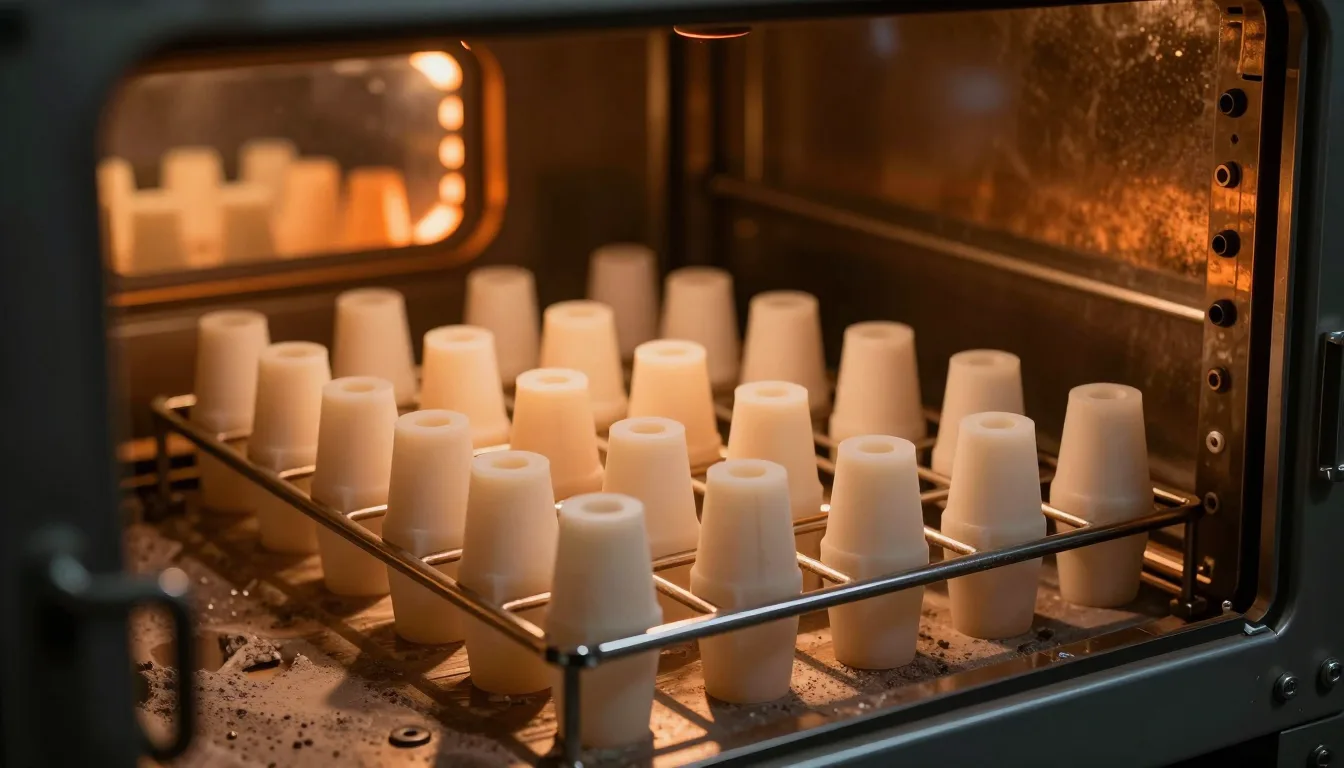
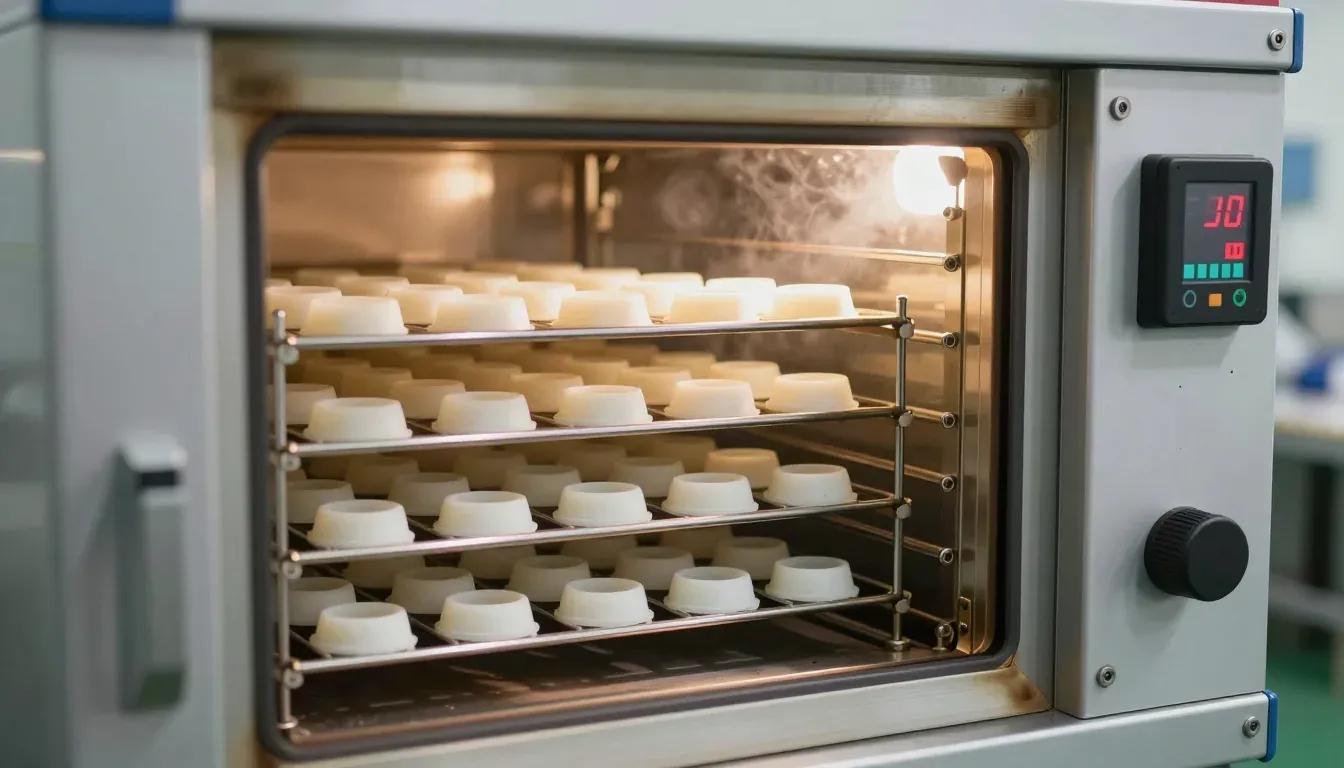
Our plugs go through a four-hour post-cure. The step drives off volatile components and stabilises hardness. Without it, a silicone part can feel tacky on the first trip through the oven. Consistent behaviour from one batch to the next depends on that stability.
Oven setpoint is not part temperature
The oven display shows air temperature. Part temperature depends on mass, surface colour, hanging arrangement and position inside the chamber. A dark part absorbs radiant heat faster. The zone near the door can run a few degrees hotter than the centre. A part on the top rack meets different air than one at the bottom.
That is why the setpoint alone is a weak basis for plug selection. You need the hottest area of the part and the time spent there. If the oven has a recorder, read the peak on the cure curve. If it does not, run a few loads with a contact probe on the part and build the real curve. It is one of the cheapest investments a coating shop can make.
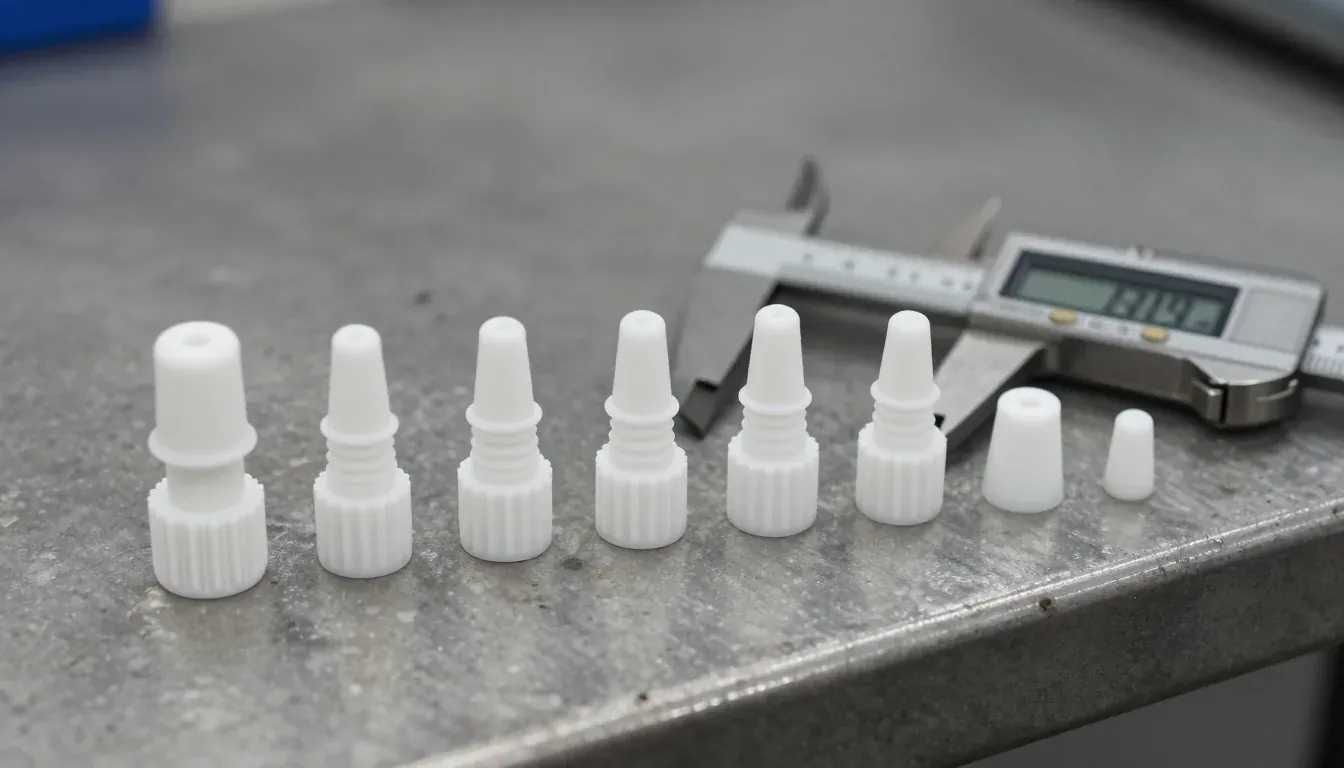
Hanging geometry belongs in the same picture. A hole facing down pushes the plug outward with gravity. A hole facing up collects powder at the mouth. In both cases retention matters as much as temperature. Wide-head parts such as SCT flanged conical plugs behave more predictably under that kind of load.
Dwell time and part mass
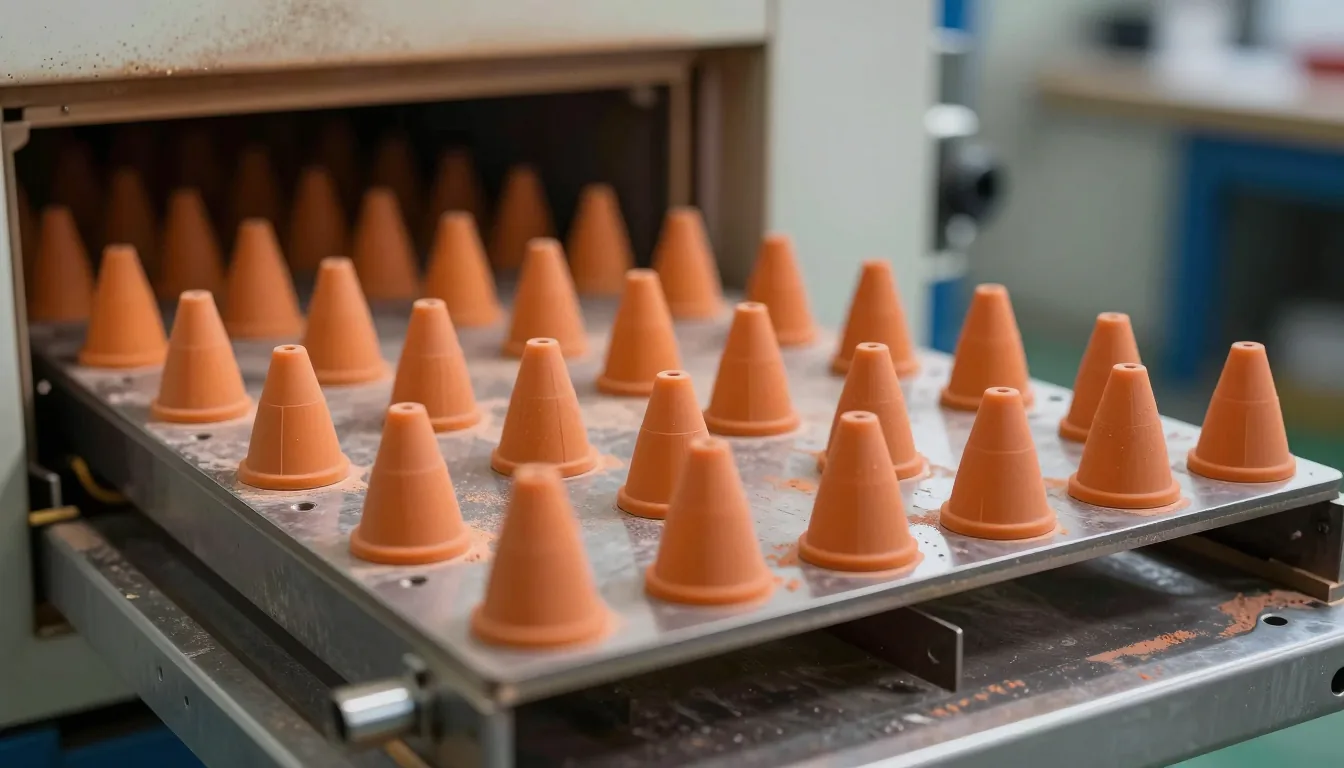
The total heat load on a plug is closer to temperature multiplied by time than to temperature alone. Ten minutes at 200 °C and forty minutes at 200 °C are not the same event. Long cycles accelerate hardening, reduce elasticity and raise the risk of tearing during removal. Thick parts with long cure times need a more careful plug choice.
Mass delays heat through the section. Thin sheet approaches oven temperature shortly after it enters. The core of a heavy casting lags for minutes. Because the plug sits at the hole mouth, it usually sees a temperature close to the surface. Even so, the heating rate around the plug location deserves its own check on thick parts.
A practical rule: select for a peak at least 30 °C above the oven setpoint. That covers short events such as a controller fault or an open door. Continuous operating temperature should stay below the continuous rating with room to spare.
Loading density changes the calculation as well. A rack packed tight slows the air movement between parts and stretches the cure. A sparse load heats faster. The same recipe produces two different heat curves. A shop that tracks plug life should log the loading pattern too, because it explains repeat failures that the temperature record alone cannot.
Process temperatures and where each plug fits
The table lists typical bands found on surface finishing lines. The last row is the paint stripping oven, where silicone plugs are not used; we explain that separately.
| Process | Typical temperature | Masking note |
|---|---|---|
| Liquid paint drying | 80-150 °C | A PVC vinyl cap can be enough |
| Plastisol curing | 170-180 °C | Silicone plug has comfortable margin |
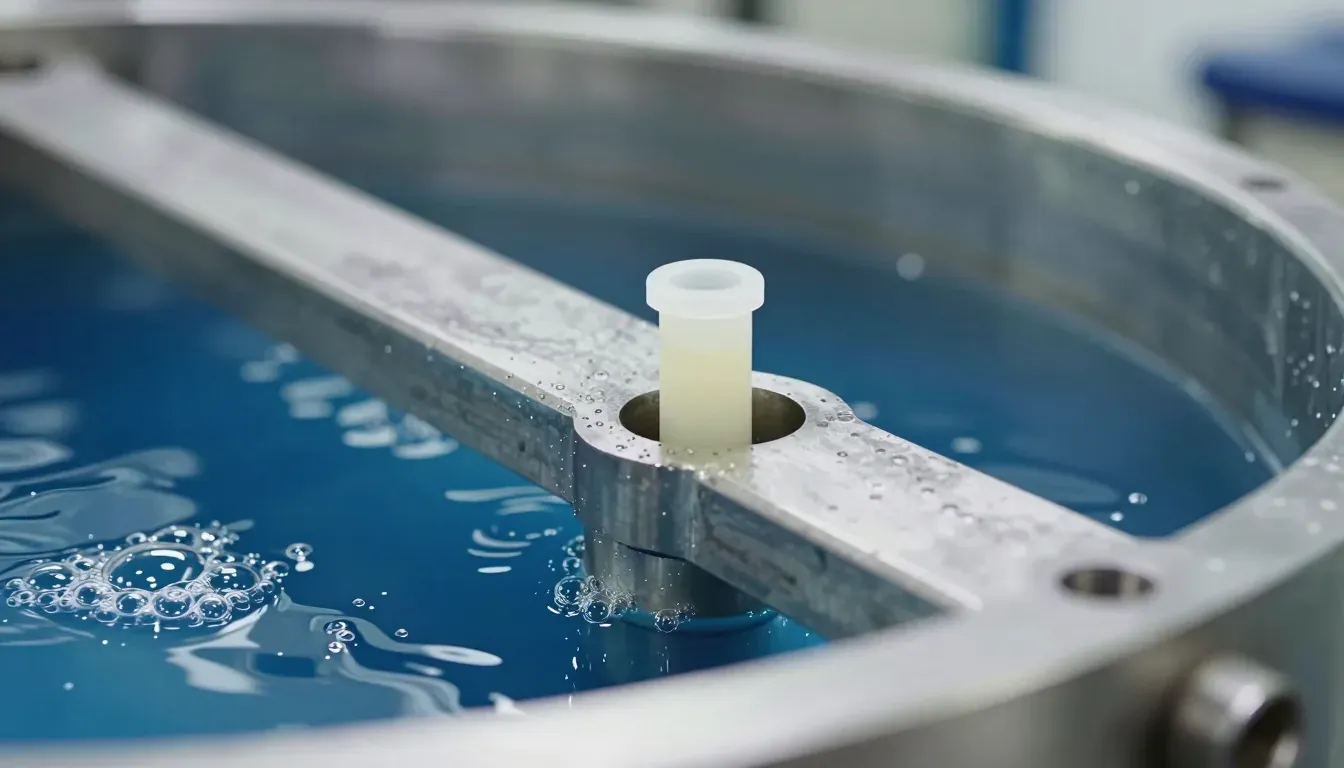
| E-coat curing | 180-200 °C | Chemical resistance and sealing matter most |
| Powder coating cure | 180-220 °C | Suitable band for standard silicone plugs |
| Polyester masking tape | 0-200 °C | Tape and plugs can be used together |
| Kapton tape | 0-260 °C | High-temperature surface masking |
| Silicone plug continuous limit | -90-260 °C | 315 °C short peak |
| Paint stripping oven | 425-485 °C | Silicone plugs are not used here |
The bands come from our product data. If a line runs above 220 °C, revisit the choice. A powder oven at 240 °C still sits below the standard limit, but the margin shrinks. On that line a flanged, thicker body usually outlasts a thin one.
What happens above 315 °C
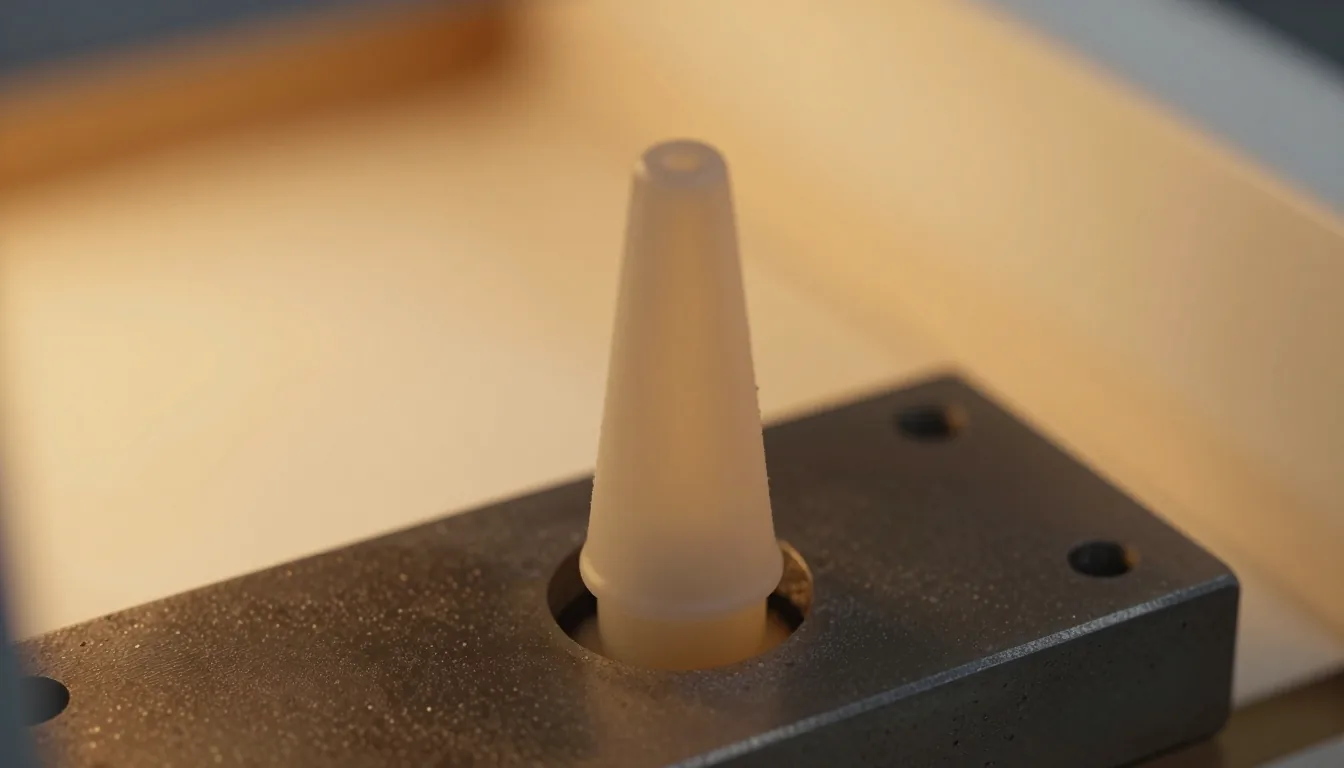
Paint stripping ovens run at 425-485 °C. Silicone plugs are not used at that temperature. The material hardens, cracks and can leave fragments in the hole. If masking is required on a stripping line, a different method is needed. The equipment category for paint stripping ovens and plastisol coating lines is built around that distinction.
The 315 °C ceiling applies to a short excursion only. A plug that sits at that temperature for minutes is outside its data range. Some lines preheat parts before stripping. If a plug is part of that procedure, temperature and duration have to be evaluated together. "It handles 315 °C" on its own says nothing useful.
PVC vinyl has a similar boundary. Its range is -60 °C to +177 °C. Using a PVC cap in a powder oven above 180 °C invites softening and slippage. PVC is cheaper and stiffer, which makes it a good option for liquid paint drying and lower-temperature wash lines. Above 177 °C, switch to silicone. The vinyl PVC plug caps category lists those limits product by product.
How to choose the right product
Temperature resistance alone is not enough. Work through five steps:
- Write down the continuous temperature. Use the hottest sustained temperature the part sees, not the setpoint.
- Record the peak and its duration. Include door openings, first loading and controller faults.
- Measure dwell time. Total time on the cure curve drives the heat load.
- Describe the chemical environment. E-coat bath, degreaser and paint chemistry all affect the material.
- Keep a margin. Continuous temperature should sit at least 30-40 °C below the product limit.
With those answers the family becomes clear. For powder coating and e-coat, look at silicone plug caps. For high-temperature surface masking, Kapton tape covers the 0-260 °C band. For lower-temperature lines, PVC vinyl is the economical option. Tape and plugs can run on the same line; geometry decides which one goes where.
Common mistakes on the floor
Most high-temperature masking failures come from a short list of recurring errors:
- Trusting the oven display: air temperature and part temperature differ. Thick parts need a real curve.
- Ignoring the peak: a short 300 °C excursion can do more damage than a long 240 °C cycle.
- Running without margin: a 260 °C plug on a 255 °C line has nowhere to go when control drifts.
- Trying PVC at high temperature: above 177 °C it softens, deforms and slides out of the hole.
- Reusing a plug indefinitely: heat load accumulates. Inspect every cycle and track batches.
All of these share one assumption: that temperature is a single number. An oven produces a curve. What the plug experiences is the area under that curve.
Monitoring and records
The oven record is the most concrete evidence of masking quality. Log the setpoint, the actual air temperature and, where available, a part probe reading for each load. If a problem appears, you can trace which batch saw which curve. Combined with plug life, that record also supports reuse decisions.
On the plug side, track batch number and production date. Plugs from the same batch saw the same post-cure and behave alike. When batches are mixed, a complaint about plugs shifting in the oven cannot be traced to one source. Keeping batches separate in stores makes the floor easier to control.
Frequently asked questions
How long does a 260 °C continuous rating last?
It covers repeated cure cycles across the product life, but every cycle adds heat load. A plug on a 260 °C line will have a shorter life than one on a 200 °C line. Batch inspection and scheduled replacement are the practical approach.
Is a brief excursion to 315 °C a problem?
The data sheet defines that ceiling for short peaks. Duration and frequency still matter. A plug that sees 315 °C every cycle will harden within a few runs. Know how long the peak lasts and how often it occurs.
Can PVC be used in a powder coating oven?
If the oven stays below 177 °C, yes. Standard powder ovens run at 180-220 °C, and PVC softens in that band. Use silicone there.
What masking works in a paint stripping oven?
Silicone plugs are not used at 425-485 °C. That process needs a different masking strategy. Share the part geometry and the surface requirement after stripping, and the method can be selected together.
How do I measure the real plug temperature?
Place a contact probe or a heat label on the part near the plug location. The oven air temperature alone does not answer the question.
Looking for Professional Silicone Masking Solutions?
As YÜZEYTEK, we provide professional silicone masking and industrial coating solutions worldwide. Contact us immediately for your needs.
Related Posts
Why 4-Hour Post-Cure? Molecular Completion of Silicone Compound
Plugs for E-Coat: Why Silicone and How They Stay